What Affects the Cost of Concrete Sealing in Ontario?
Ask a Question
Send us a note and we'll get back to you — usually within one business day.
The cost of concrete sealing in Ontario comes down to a few practical things: how much surface you have, what condition it is in, how much preparation it needs and which sealer suits it. In the Greater Toronto Area, the climate adds its own layer, because freeze-thaw cycles, road salt, spring rain and summer sun all affect how a concrete surface should be cleaned, prepared and sealed. The only reliable way to price your project is a written quote after someone has actually looked at the surface, because no two driveways, patios or walkways are alike.
1. How much surface you are sealing
Size is usually the biggest factor. A long double driveway takes more cleaning, more product and more time than a short front walkway, so it naturally costs more to seal. When you measure, include every section that will be sealed: the main slab, the apron, any walkways and steps, and a side yard or rear patio if it is part of the job.
Layout matters almost as much as square footage. Straight, open concrete is faster to work on than a surface with tight corners, stairs, planters or curved borders. Several small sections take more setup and edging than one continuous slab, even when the total area is the same.
2. The condition of the concrete
Concrete that has been maintained seals more affordably than concrete that has been neglected. Cracks, chips, spalling (the surface flaking away), oil stains, rust marks and efflorescence all add preparation time. A sealer will not hide those problems; they have to be cleaned, repaired or at least assessed first, and that work is part of the quote.
Old sealer is another factor. If a previous coating is worn, peeling or blotchy, it has to be removed or properly prepared before anything new can bond. Left in place, a failing sealer will lift again and take the new product with it.
3. The type of concrete and sealer
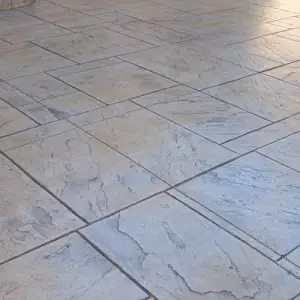
The surface itself changes the approach. Plain poured concrete, exposed aggregate and pattern (stamped) concrete each absorb and hold a sealer differently. Stamped concrete in particular is often sealed to protect and deepen the colour, and it needs an even coat so the sealer does not pool in the pattern lines. For natural stone and stamped concrete cleaning and sealing, preparation and product choice matter even more, because the colour and the pattern are part of the look.
The sealer is chosen for the surface and the finish you want. Some sealers leave a wet, colour-rich look; others go on closer to matte. Some are made for a driveway that sees road salt, others for a patio or pool deck. The right product depends on the concrete and how it is used, so it is worth asking which sealer is being proposed and why.
If you are unsure whether a particular surface can or should be sealed, ask us whether it suits your surface — we will tell you what we would and would not apply.
4. Ontario’s climate, salt and drainage
Concrete in the GTA does not live an easy life. Water soaks into tiny pores, freezes in winter and expands, which is what causes surface flaking and cracks over time. A proper sealer slows that water absorption, but it works best when the concrete is clean, dry and free of loose material before it goes on.
Road salt and de-icer are a fact of an Ontario winter. Salt sitting on a sealed surface is much easier to manage than salt driven into bare concrete, where it draws in moisture and encourages damage through freeze-thaw cycles. This is why driveways and walkways that meet the road get extra attention in the fall.
Spring rain and drainage also matter. Much of Scarborough and the surrounding area sits on clay soil, which drains slowly and holds water against the edges of slabs and foundations. Sealing protects the surface, but it is not a fix for poor grading or standing water. If water pools on your concrete or drains toward the house, that should be looked at separately so the sealer is not asked to do a job it cannot do.
Summer UV is the quieter problem. Sun breaks down unprotected sealer, dulls colour and dries out the surface over time. A sealer with UV resistance and a sensible reapplication schedule keeps the finish looking better, longer — see our guide on how long concrete sealing lasts in Ontario.
5. Access, timing and the weather window
How easily a crew can reach the surface affects how long the job takes. A backyard patio reached only through a gate or up stairs is slower to service than a front driveway right off the street. Nearby landscaping, fencing and furniture also need to be worked around or protected.
Ontario weather dictates when sealing can happen. Most sealers need a dry surface and a workable temperature range, so the job has to be scheduled around rain and cooler mornings. That is normal in the GTA, and it is one reason a good contractor plans the work rather than rushing it between storms.
When you compare quotes, make sure you know what is included. A clear quote should spell out:
- Cleaning and preparation of the surface
- Any repairs made before sealing
- The type of sealer and the number of coats
- Drying time and when you can walk or drive on the surface again
Frequently Asked Questions
How long does concrete sealing take?
It depends on the size and condition of the surface, and on the sealer used. Cleaning and preparation usually take longer than the sealing itself, and some sealers need drying time between coats. The written quote should tell you what is being done and in how many visits.
Does sealing fix cracks in concrete?
No. A sealer protects the surface, but it will not repair cracks, spalling or shifting. Those issues should be assessed and addressed as part of the preparation, before the sealer goes on.
Can I seal concrete myself?
You can, but the results usually come down to preparation. If the concrete is not properly cleaned, dry and free of old coatings, even a good product will fail early. Proper surface preparation is usually the difference between a finish that lasts and one that peels within a season or two.
When is the best time to seal concrete in Ontario?
Late spring through early fall, when temperatures are warm and the surface can dry thoroughly. Rain, cool nights and early frost narrow the window, so many GTA homeowners book sealing in the summer and early fall before the snow arrives.
Seal Tech Inc. serves Scarborough and the Greater Toronto Area. Call (416) 966-4200 for a free written quote, or reach us through our contact page.